



TABLE OF CONTENTS
Could 80% of enterprise AI workloads run on open-weight models, leaving frontier models for the rest? That was the question our panel took on in Berlin.
Hyperstack brought together industry leaders in Berlin for a panel discussion on open and frontier AI models, followed by an evening of networking. The panel featured Rod Evans, VP Supercomputing at NVIDIA; Ye Huang, General Manager of Solutions at Alibaba Cloud Central Europe; Darren Franklin, Chief Technologist, Data and AI at Computacenter and Gareth Mitchell Jones, Head of AI at Daemon. The discussion was moderated by Hiren Parekh, Sales Director at Hyperstack.
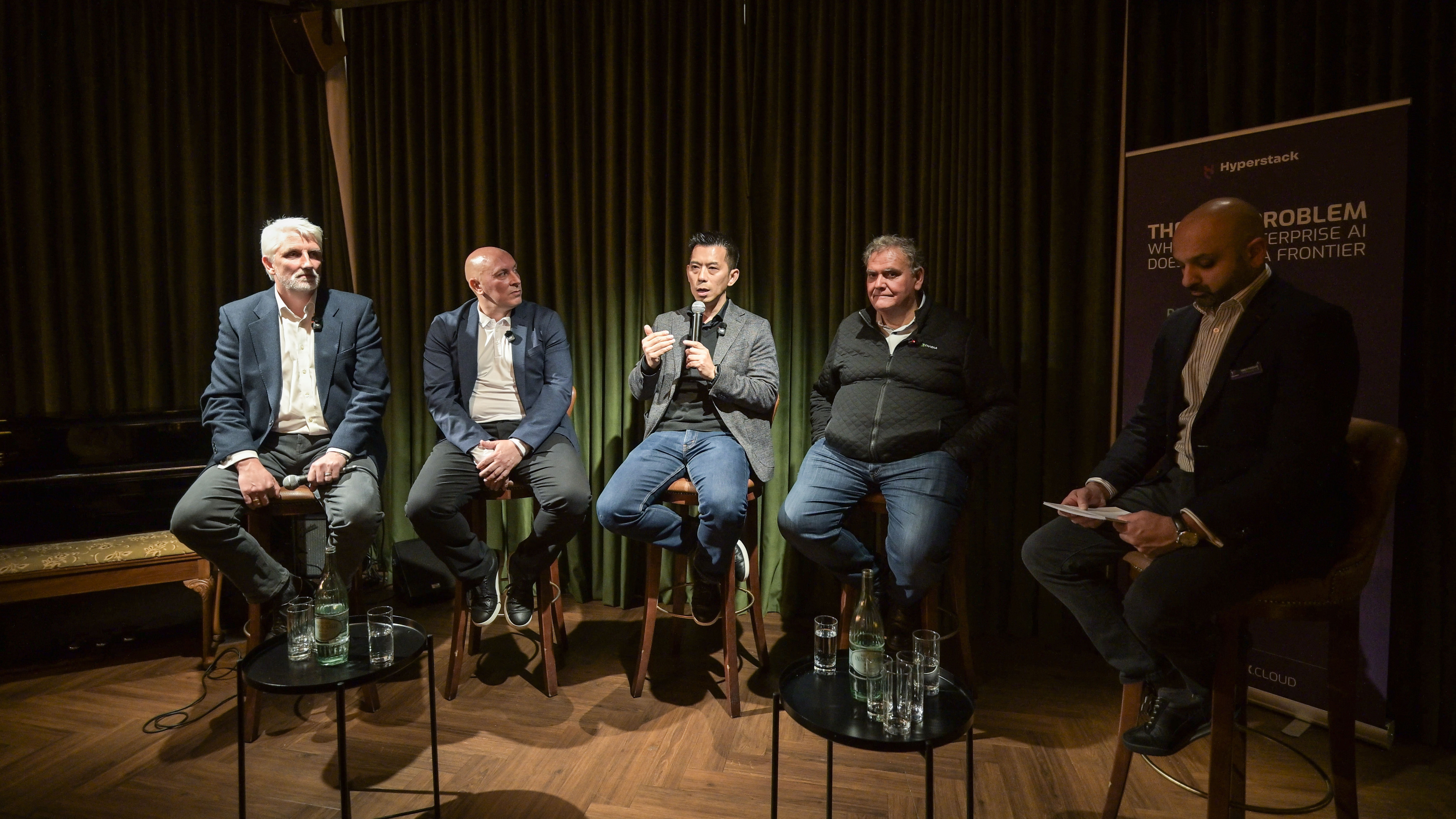
What follows are the key takeaways for enterprises weighing their AI strategy.
The gap between open and frontier models is closing
As Hiren noted during the discussion, open-weight models have caught up quickly in what they can deliver. That shift changes the build vs buy calculation. For many organisations, owning and maintaining their own AI stack is no longer a distant option. It is becoming a realistic alternative to long-term managed subscriptions.
-
Gareth pointed to the public sector as an example. Organisations with high volumes and consistent workloads can afford to build and fine-tune models on private or rented compute. They do not have to rely on frontier models alone, and the engineering investment can deliver a better total cost of ownership over time.
-
Ye offered the counterpoint. Frontier models still lead on cutting-edge capability, and the pace of competition is intense, with new language, multimodal and voice models arriving every month. If staying at the very top of that curve matters, frontier models are where you will find it. They also come as a managed service, which removes much of the operational burden from the customer.
-
Darren added that this operational simplicity is exactly why frontier models are so popular. In his view, their strongest use cases are highly complex, ad hoc problems that need significant computational power but do not follow a repeatable pattern.
So what about the 80% figure? Gareth was clear that there is no single answer. Some businesses say they could handle 90% of their use cases with open-weight models. Others put it closer to 30 or 40%. The real question is not how many workloads could move but which tasks genuinely need frontier capability.
Control over data is driving demand
When asked where demand for open-weight deployment is coming from, Rod started with control. He prefers to talk about regional or autonomous models, meaning data and models that remain under the control and jurisdiction of the country an organisation operates in.
He also highlighted why this is harder than it sounds. A company like BMW is headquartered in Germany but runs manufacturing plants in China, Brazil, Mexico and South Africa. Forcing a global business to keep everything in one region does not work. At the same time, few organisations want all of their data and models sitting under a foreign jurisdiction. Open-weight models give them a way to decide where each part of their data and models lives, keeping the most sensitive data close to home while supporting operations across multiple regions.
Darren sees the same pattern. Many of his customers are headquartered in one jurisdiction but operate globally, while central and local government customers need tighter control over their outputs.
Ye focused on the technical advantages. Open-weight models can be inspected and tested in detail, which matters for organisations running in constrained environments where only a small group can access the data. They also allow deep integration with agent harnesses, hardware and enterprise software, giving engineering teams far more room to build. For regulated sectors such as pharma and banking, which face very different requirements from e-commerce businesses, control over the deployment environment is the number one value open-weight models offer.
Smaller open-weight models are also moving beyond the data centre. Ye noted they now run on laptops, phones and in vehicles and Darren is seeing more AI-capable desktop machines with open-weight models built in.
However, Gareth warned that clarity is still lacking. Engineering for multiple jurisdictions takes careful planning and governance, and many companies are racing ahead without it. He expects a compliance headache as legislation catches up. That uncertainty around data residency and jurisdictional requirements is itself slowing adoption
Hybrid is the likely end state
Across the panel, the consensus was that enterprises will not choose one approach over the other. They will run both.
Gareth described the split clearly: use frontier models for work that is not risky, and keep open-weight or private deployments for use cases you understand well, can define precisely and can tune models for. Rod agreed, suggesting frontier models make sense when you need something done quickly or want a fully supported service, while open-weight models suit internal and sensitive workloads. Darren expects this hybrid approach to continue for many years, shaped by each organisation's sector, customers and priorities.
The challenge is knowing which option fits where. Darren noted that customers have never had more choice in where to deploy AI, from private cloud to the edge to the desktop. That is a benefit, but too much choice also creates indecision. Some organisations lack the data centre capacity or budget to deploy internally and need an infrastructure partner. Others are dealing with deployment locations so spread out that governing each one becomes a task in itself.
As Gareth put it, one model will not fit every use case. Enterprises need clear guidance on which models and deployment options suit which workloads, so their teams can move forward rather than stall.
Getting to production is easier than staying there
If there was one message every panellist returned to, it was this: deploying a model is the easy part.
-
Darren described it with a familiar line: with great power comes great responsibility. The more control an organisation takes over its AI, the more it owns. That includes security, guardrails, observability, versioning, deployment and eventually retirement. In his words, the easy part is putting something into production. The hard part is running it consistently for three years while maintaining capability and compliance.
-
Rod raised the question of support. Linux became the operating system of choice for enterprises not simply because it was open, but because companies like Red Hat stood behind it with patches and maintenance. Few chief executives would bet their business on software nobody supports. He argued that if someone offers enterprise-grade support for open-weight models, the market could shift in the same way it moved from Unix to Linux.
-
Gareth explained why staying in production is so demanding. Running open-weight models in-house means investing in evaluations, engineering and keeping models up to date, and the skills to do that are scarce. Fine-tuning, quantisation and hardware optimisation all take time to learn. Evaluations need to be properly designed around a consistent golden data set. As he pointed out, you cannot simply ask a frontier model to write your evals and hope it gets everything right.
Rod added that data quality remains the biggest reason AI projects fail. Data pulled from business intelligence systems is often in the wrong structure, and getting it into the right format takes significant work before any model can deliver results.
Taken together, the panel described two types of blockers:
-
Technical readiness: security, infrastructure, model choice and deployment method.
- Organisational readiness: clear owners, review processes, a way to recover when something goes wrong and accountability for outcomes.
Ye summed up the organisational side. Adopting AI in production is not only a technology integration. It means connecting models to surrounding systems, processes and people, with owners who are comfortable with the review process and know how to fix problems. Openness preserves choice, but production discipline is what creates trust. In Yi's experience, most enterprises are heading in this direction but are not yet ready.
Ye's view of what customers actually want was simple. Enterprises are not satisfied with an inspiring demo. In production, they want AI to be as boring as possible: running reliably, repeatedly and in a way that can be reviewed every Monday morning. Enterprises buy reliable capability, not impressive demos.
Legacy code and modernisation
Keeping open-weight models useful over time depends on internal skills, how adaptable the model is and the lifecycle processes around it.
Rod pointed to the skills gap as the biggest issue across industries. After Y2K, many companies moved from building software in-house to buying it off the shelf, and in-house programming capability declined over the following two decades. As a result, many organisations today do not have the skills to build and maintain their own AI systems. At a UK AI forum Rod has been running, access to skilled people has come up as the number one issue at every meeting.
Gareth explained what that maintenance looks like in practice. Models need to be fine-tuned for the specific task they support, which can mean running several versions of the same model tuned in different ways. When a model is upgraded or swapped, much of that work has to be redone. Teams need to check whether the new model behaves the same way as the old one, since models are not all built alike and the data behind them varies. Engineering for results that are accurate, reliable and consistent every time is hard work, and it is ongoing.
Where to start
The panel’s advice was consistent: start with value, not with the technology.
-
Gareth set out a simple test. If the value is not there, do not do the use case. The same applies if the volume is not there, or if the business problem is not clearly understood. AI is not a silver bullet, and it is not needed for every project. Sometimes a simpler statistical approach or intelligent automation will do the job at a lower cost, without the engineering that AI requires.
-
Darren recommended starting with use cases that offer high business value but low criticality from a risk or compliance perspective. As he put it, any use case that is not going to get you in the news is a good starting point. Simple tasks such as classification can deliver real value without putting the business at risk.
-
Rod stressed the importance of thinking through return on investment before starting. He shared the example of his nephew, an electrician, whose company now uses AI to review photos of completed wiring and certify the work. The paperwork that used to take up a large part of his week has been cut back, so he now spends more of his time doing electrical work. The approach is not complicated, but it is the result of someone thinking carefully about how AI can improve productivity.
-
Ye pointed out that the easiest win looks different for each team. For finance teams, it is about controlling cost. For engineers, it might mean running models locally on their own laptops using their existing API know-how. Yi also noted that many enterprise CFOs no longer accept that every task needs the largest model available. A compact model fine-tuned for repeated, well-defined tasks and run in your own environment can reduce costs significantly, which helps keep AI innovation sustainable.
How Hyperstack helps
The themes from Berlin- control, supportability and a clear path from pilot to production- are the same challenges Hyperstack is built to address.
-
Secure Private Cloud gives enterprises dedicated, secure infrastructure for running AI where they need full control over where their models and data live. It suits organisations in regulated sectors, those with strict data requirements and those that want to run open-weight models in production without building and operating their own data centre capacity.
-
On-Demand GPU VMs give teams a fast way to pilot and benchmark open-weight models before committing to production. Teams can test performance, compare unit economics and validate use cases, then move proven workloads into a dedicated environment when they are ready.
Together, they give enterprises a practical path from first pilot to long-term production, with the control and support that running AI at scale requires.
Answering the 80% Problem
The panel's answer was clear: the decision is no longer open vs frontier but which workload goes where and who supports it long term.
If you are working out where open-weight models fit in your AI strategy, talk to our team about Secure Private Cloud and book a meeting below.

Subscribe to Hyperstack!
Enter your email to get updates to your inbox every week