



TABLE OF CONTENTS
NVIDIA H100 SXM On-Demand
Key Takeaways
- Object storage is the foundation for managing large volumes of unstructured cloud data, including AI datasets, media files, backups, and archives. Its API-driven design allows you to scale storage independently of compute, making it ideal for modern cloud environments.
- S3 compatibility is no longer optional in 2026. Most AI frameworks, data pipelines, and cloud-native applications are built around S3 APIs, making compatibility critical for flexibility and avoiding vendor lock-in.
- Pricing models vary significantly across providers. While hyperscalers offer powerful ecosystems, their tiered pricing and additional fees can become unpredictable at scale. Usage-based pricing offers better long-term cost control.
- Different object storage providers excel at different workloads. AWS, Azure, and Google are strong for ecosystem-driven use cases, while Wasabi and Hyperstack focus on simplicity and cost efficiency.
- Hyperstack Object Storage is well-suited for high-volume unstructured data workloads, offering full S3 compatibility, resilient architecture, and precise usage-based pricing that scales with your needs.
If you’re working with large volumes of cloud data, object storage is not an option anymore. No matter if you’re managing AI training datasets, media libraries or long-term archives, choosing the right object storage solution affects performance.
In this blog, you’ll learn what object storage is, why you need it and which solutions stand out as the best object storage solutions for cloud data in 2026. We’ll break down features, pricing models and ideal use cases so you can confidently choose the right option for your workloads.
What is Object Storage
Object storage is a data storage architecture designed to store and manage large amounts of unstructured data. Instead of organising data into files and folders, object storage stores data as individual objects, each containing the data itself, metadata and a unique identifier.
Because objects are accessed via APIs rather than traditional file systems, object storage can scale horizontally without performance bottlenecks. This makes it ideal for cloud environments where data volume grows at scale.
Unlike block or file storage, object storage is built for durability and accessibility over performance-sensitive operations. That’s why most cloud-native applications rely on object storage.
Why Do You Need Object Storage
If your data keeps growing and your infrastructure keeps getting more complex, object storage solves problems that traditional storage systems struggle with:
- Scalability: Object storage scales horizontally without limits. You can store millions or billions of objects without managing file systems, directories or capacity planning.
- Cost efficiency: You pay only for what you store and use. Object storage is cheaper than block or file storage for large, growing datasets.
- Unstructured data support: Object storage is designed for unstructured data like images, videos, logs, backups and AI datasets which don’t fit well into traditional storage models.
- Cloud-native compatibility: Most modern applications, AI pipelines and data platforms are built around S3-compatible APIs which makes object storage easy to integrate.
- High durability: Object storage platforms replicate or erasure-code data across multiple devices or zones, protecting your data from hardware failures.
- Metadata-driven access: Each object includes rich metadata so you can tag, search, and retrieve data efficiently without relying on directory structures.
6 Best Object Storage Solutions for Cloud Data in 2026
Below is a comparison of the top object storage solutions you should consider based on features, use cases and pricing.
| Provider | Ideal For | Key Features | Pricing Model |
|---|---|---|---|
| Hyperstack Object Storage | AI/ML datasets, backups, media, archives | S3-compatible, cost control, efficient metadata, resilience | Pay for what you use |
| AWS S3 | Enterprise, scalable cloud data storage | 99.999999999% data durability, global reach, deep ecosystem, lifecycle policies | Tiered pay-as-you-go |
| Cloudian HyperStore | AI, machine learning, analytics and data lake environments | S3 compatibility, scale-out architecture, hybrid cloud support, enterprise security | Quote-based pricing depending on deployment size, configuration, hardware and support requirements |
| Wasabi Hot Cloud Storage | Cost-sensitive workloads | Simple pricing, high performance, no egress fees | Flat-rate storage pricing |
| Azure Blob Storage | Microsoft ecosystem, hybrid cloud | Deep Azure integration, storage tiers, lifecycle management | Tiered per-GB storage + operations |
| Google Cloud Storage | AI/ML pipelines, global applications | Multi-regional support, AI integration, security features | Storage + network + operations pricing |
List of Best Object Storage Solutions for Cloud Data in 2026
Check out below the best object storage solutions you should use for managing cloud data.
1. Hyperstack Object Storage
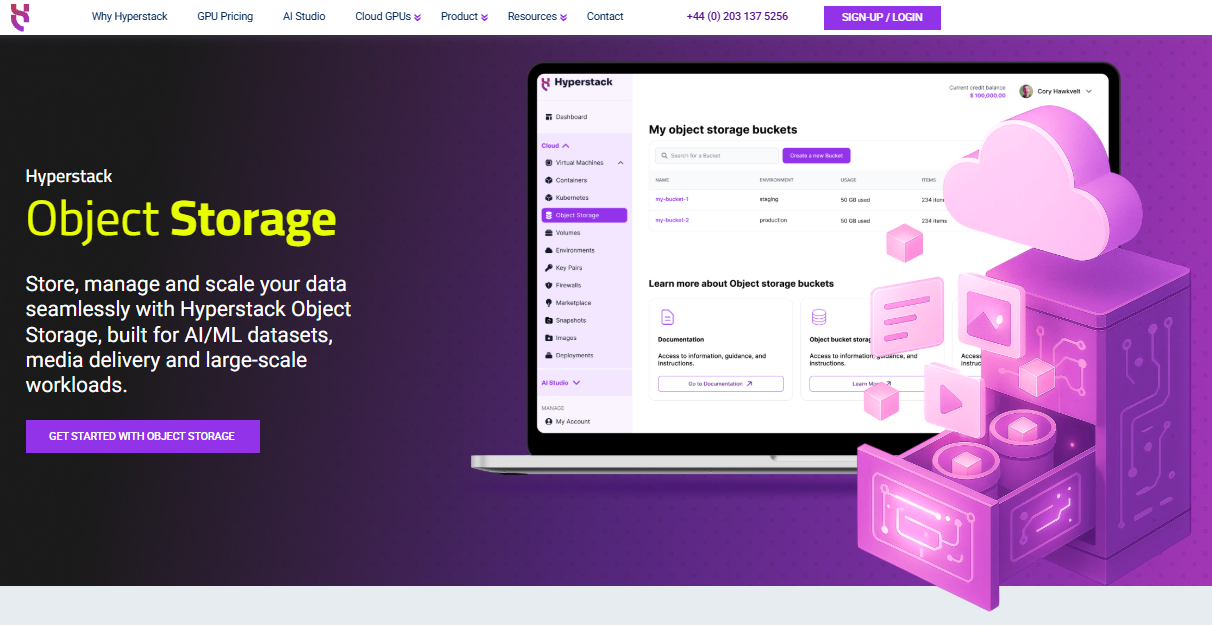
Hyperstack Object Storage is a scalable object storage solution designed to handle unstructured data at any scale. Built on fully S3-compatible technology, it provides a secure, flexible and API-ready way to store AI datasets, backups, media files and long-term archives.
Key Features of Hyperstack Object Storage
Below are the key features of Hyperstack Object Storage:
- Cost control: Designed for high-volume usage, Hyperstack Object Storage uses a pay-as-you-go pricing model. You can store large amounts of data while keeping costs predictable and transparent.
- Fully S3 compatible: Hyperstack Object Storage works seamlessly with existing tools and SDKs such as S3cmd, Boto3 Python SDK, MinIO Client (mc), and other S3-compatible applications.
- Optimised for unstructured data: Store and manage logs, datasets, media files, and other unstructured data efficiently. The platform is built to handle massive workloads without performance bottlenecks.
- Metadata handling: You can attach custom metadata to every object, making it easier to categorise, search, and retrieve data quickly across large datasets.
- Multipart upload support: Large files can be uploaded faster and more reliably using multipart uploads, with parallel transfers and automatic retry handling.
- Redundancy and resilience: Your data is protected using an erasure coding scheme designed to tolerate multiple hardware failures while maintaining high durability.
Ideal Use Cases
The following use cases are ideal for Hyperstack Object Storage:
- AI and ML datasets: Because it’s fully S3-compatible, Hyperstack Object Storage integrates easily with AI frameworks like TensorFlow and PyTorch for direct access to training and inference datasets.
- Backup and recovery: You can use Hyperstack Object Storage to store secure backups and enable fast recovery to protect critical workloads from data loss.
- Media storage and delivery: Store and manage video, image and audio files at scale, with metadata tagging that enables faster content retrieval and distribution.
- Long-term archives: Hyperstack Object Storage is well-suited for long-term data archiving for durable and cost-efficient storage of rarely accessed data.
Hyperstack Object Storage Pricing
Hyperstack Object Storage uses precise usage-based metering calculated in GB-minutes for accurate billing.
Pricing: $0.000019397 per GB per hour. You pay only for the storage you actually use.
2. AWS S3
Amazon Simple Storage Service (AWS S3) is one of the most used object storage platforms in the world. S3 is designed to provide 99.999999999% data durability and 99.99% availability by default. It is an ideal choice for enterprises running cloud-native workloads.
Key Features of AWS S3
Below are the key features of AWS S3:
- Massive scalability: AWS S3 is built to store virtually unlimited amounts of data, scaling automatically as your storage needs grow without manual intervention.
- Multiple storage classes: You can choose from different tiers such as Standard, Intelligent-Tiering, Infrequent Access and Glacier to balance cost and access frequency.
- Global availability: Data can be stored across multiple regions worldwide, enabling low-latency access and geographic redundancy.
- Lifecycle management: Automated lifecycle rules let you move data between storage classes or delete objects based on age and access patterns.
- Security and compliance: AWS S3 supports encryption at rest and in transit, IAM-based access control and compliance with major industry standards.
- Deep AWS integration: S3 integrates tightly with AWS services like EC2, Lambda, SageMaker, Athena and Redshift.
Ideal Use Cases
The following use cases are ideal for AWS S3:
- Enterprise cloud storage: AWS S3 is commonly used by large organisations that already rely on AWS infrastructure for applications and services.
- Data lakes and analytics: You can use S3 as the foundation for data lakes, storing raw and processed data for analytics and business intelligence.
- Backup and disaster recovery: S3 is widely used for backup storage and cross-region replication for disaster recovery strategies.
- Application asset storage: Store static assets such as images, documents and application resources accessed by web and mobile applications.
- Generative AI: S3 stores more than 350 trillion objects (exabytes of data) for virtually any use case and averages over 100 million requests per second.
AWS S3 Pricing
AWS S3 follows a tiered pay for what you use pricing model based on usage. There is no minimum charge. For example:
- First 50 TB / Month- $0.023 per GB
- Next 450 TB / Month- $0.022 per GB
- Over 500 TB / Month- $0.021 per GB
3. Cloudian HyperStore
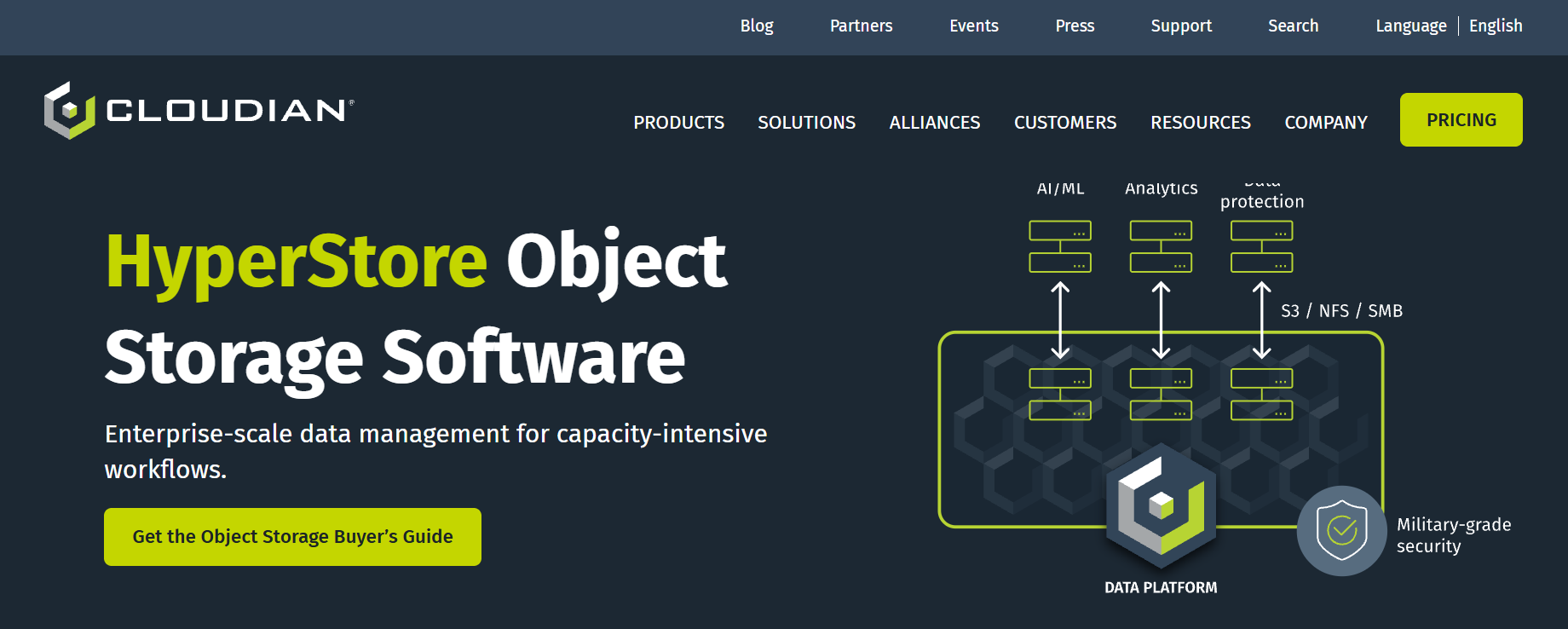
Cloudian HyperStore is an enterprise object storage platform built for large-scale private cloud, hybrid cloud and edge environments. It provides S3-compatible object storage that can be deployed on-premises, in data centres, or at the edge, making it a strong fit for organisations that need cloud-like storage while maintaining control over data location, security and infrastructure.
Key Features of Cloudian HyperStore
Below are the key features of Cloudian HyperStore:
- S3 compatibility: Cloudian HyperStore delivers strong S3 API compatibility, allowing organisations to use existing S3-based applications, tools and workflows without major changes.
- Scale-out architecture: The platform is designed to scale from terabytes to petabytes and beyond by adding nodes as storage needs grow.
- Hybrid cloud support: Cloudian supports hybrid storage strategies, helping organisations connect on-premises object storage with public cloud environments.
- Unified file and object storage: HyperStore supports object storage and can also support file access, helping teams manage different unstructured data types in one environment.
- Enterprise security: Cloudian includes features such as encryption, IAM, role-based access controls, multi-tenancy and Object Lock to help protect data from unauthorised access and ransomware.
- Data locality and sovereignty: Organisations can keep data in specific locations to meet performance, residency or compliance requirements.
Ideal Use Cases
The following use cases are ideal for Cloudian HyperStore:
- Private cloud object storage: Cloudian is well-suited for organisations that want S3-compatible object storage in their own data centres instead of relying only on public cloud services.
- Backup and ransomware protection: HyperStore can be used as a backup target with immutability and Object Lock features to help protect backup data from deletion or encryption by attackers.
- AI and analytics data storage: Cloudian can store large volumes of unstructured data for AI, machine learning, analytics and data lake environments.
- Media and rich content storage: The platform is suitable for storing video, images, audio files and other large media assets at scale.
- Hybrid cloud and edge storage: Cloudian is useful for organisations that need storage close to applications, users or devices while still integrating with cloud-based workflows.
Cloudian HyperStore Pricing
Cloudian HyperStore pricing is typically provided by quote and depends on deployment size, configuration, hardware, support requirements and whether the organisation uses software-defined storage or preconfigured appliances. Cloudian positions HyperStore as a cost-efficient alternative to traditional enterprise storage and public cloud storage for large-scale unstructured data environments.
4. Wasabi Hot Cloud Storage
Wasabi Hot Cloud Storage is an object storage service designed for simplicity and predictable pricing. It focuses on delivering high-performance storage at a lower cost. This makes it attractive for organisations that want to avoid complex tiering and egress fees.
Key Features of Wasabi Hot Cloud Storage
Below are the key features of Wasabi Hot Cloud Storage:
- Simple flat pricing: Wasabi uses a single-tier pricing model, which makes it easier to estimate storage costs without worrying about multiple storage classes.
- No egress fees: Unlike many cloud providers, Wasabi does not charge for data egress, which can significantly reduce costs for data-intensive workloads.
- S3-compatible API: Wasabi supports S3-compatible APIs, allowing you to connect existing tools and applications without major changes.
- High performance: Designed as “hot” storage, Wasabi delivers consistent performance suitable for frequent access workloads.
- Data immutability: Wasabi supports object lock and immutability features, helping protect data from accidental deletion or ransomware attacks.
Ideal Use Cases
The following use cases are ideal for Wasabi Hot Cloud Storage:
- Backup and recovery: Wasabi is commonly used as a cost-effective backup target due to its simple pricing and lack of egress fees.
- Media storage: Store and access large media files such as video and audio without worrying about retrieval costs.
- Archive replacement: Wasabi can replace traditional archive storage when you want fast access without complex tiering.
- Cost-sensitive workloads: Ideal for teams that need predictable monthly storage costs without hidden charges.
Wasabi Hot Cloud Storage Pricing
Wasabi Hot Cloud Storage offers affordable cloud storage pricing that's up to 80% less than the hyperscalers. You pay as you go every month. Starting at $6.99 TB/month.
5. Microsoft Azure Blob Storage
Microsoft Azure Blob Storage is a cloud object storage service designed for large-scale unstructured data. It integrates with the Azure ecosystem, which is why it is a natural choice for organisations already running applications, analytics or AI workloads on Microsoft Azure.
Key Features of Microsoft Azure Blob Storage
Below are the key features of Microsoft Azure Blob Storage:
- Multiple access tiers: Azure Blob Storage offers Hot, Cool and Archive tiers, so you to optimise storage costs based on how frequently data is accessed.
- Tight Azure integration: Blob Storage works seamlessly with Azure services like Azure VMs, Azure Data Factory, Azure Synapse and Azure Machine Learning.
- Lifecycle management: You can automatically move data between tiers or delete it using lifecycle policies based on age or access patterns.
- Enterprise-grade security: Supports encryption at rest and in transit, role-based access control (RBAC), and private networking options.
- Global availability: Azure Blob Storage is available across multiple regions for redundancy and compliance with data residency requirements.
Ideal Use Cases
Below are the use cases of Microsoft Azure Blob Storage:
- Microsoft-centric environments: Best suited for organisations already using Azure for compute, databases or identity management.
- Enterprise backups: Frequently used for structured and unstructured backup storage within Azure-based infrastructures.
- Data analytics pipelines: Works well as a storage layer for analytics and data processing workflows on Azure.
- Hybrid cloud storage: Useful for hybrid scenarios where on-premises systems integrate with Azure cloud storage.
Microsoft Azure Blob Storage Pricing
The total cost of block blob storage depends on:
- Volume of data stored per month.
- Quantity and types of operations performed, along with any data transfer costs.
- Data redundancy option selected.
For example:
|
Data storage prices pay-as-you-go |
Premium |
Hot |
Cool |
Cold |
Archive |
|
First 50 terabytes (TB)/month |
$0.15 per GB |
$0.018 per GB |
$0.01 per GB |
$0.0036 per GB |
$0.002 per GB |
6. Google Cloud Storage
Google Cloud Storage (GCS) is a highly scalable object storage service built for global applications, analytics and AI workloads. It’s designed to deliver strong performance, high durability and tight integration with Google Cloud’s data and machine learning services.
Key Features of Google Cloud Storage
Below are the key features of Google Cloud Storage:
- Multiple storage classes: Google Cloud Storage offers Standard, Nearline, Coldline and Archive classes, so you can balance cost and access frequency.
- Global and multi-regional storage: You can store data in specific regions or across multiple regions for improved availability and low-latency access.
- Strong AI and analytics integration: GCS integrates natively with BigQuery, Vertex AI, Dataflow, and other Google Cloud analytics and AI services.
- High durability and reliability: Data is stored with built-in redundancy to protect against hardware failures and regional disruptions.
- Security and access controls: Supports encryption by default, IAM-based permissions, and private access options.
Ideal Use Cases
Below are the use cases of Google Cloud Storage:
- AI and machine learning pipelines: Commonly used to store training data and model artefacts for AI workloads running on Google Cloud.
- Global application storage: Suitable for applications that require fast, reliable access to data across regions.
- Analytics and data lakes: Works well as a storage foundation for large-scale analytics and data processing.
- Media and content storage: Store and distribute large media files efficiently across global users.
Google Cloud Storage Pricing
Google Cloud Storage pricing is based on your:
- Data storage
- Data processing
- Network usage
- Anywhere Cache
For example:
|
Standard storage |
Nearline storage |
Coldline storage |
Archive storage |
Anywhere Cache storage |
|
$0.000027397 / 1 gibibyte hour, per 1 month/account |
$0.000013699 / 1 gibibyte hour |
$0.000005479 / 1 gibibyte hour |
$0.000001644 / 1 gibibyte hour |
$0.0003 / 1 gibibyte hour |
Conclusion
Choosing the best object storage solution depends on your needs. Factors like data volume, access frequency, budget predictability, ecosystem compatibility and workload type all play a role.
If you’re deeply embedded in a hyperscaler ecosystem, services like AWS S3, Azure Blob Storage or Google Cloud Storage may be ideal. However, if your priority is fully S3-compatible object storage with transparent, usage-based pricing, especially for AI datasets, backups, media or long-term archives, Hyperstack Object Storage is a scalable choice. It gives you the flexibility of S3 without the pricing complexity that often comes with hyperscalers.
Try Hyperstack Object Storage!
FAQs
What is the best object storage solution in 2026?
Hyperstack Object Storage is the best object storage solution in 2026. It is fully S3-compatible object storage with transparent, usage-based pricing for AI datasets, backups, media or long-term archives.
Why is S3 compatibility important for object storage?
S3 compatibility allows you to use existing tools, SDKs, and applications without rewriting integrations, making it easier to migrate, scale, or switch providers.
Is object storage suitable for AI and machine learning workloads?
Yes. Object storage is ideal for AI and ML workloads because it scales easily, supports large datasets, and integrates directly with popular machine learning frameworks.
How does object storage pricing work?
Object storage pricing is usually based on stored data volume, operations, and data transfer. Usage-based models provide better predictability for large-scale storage needs.
Can object storage be used for long-term data archiving?
Yes. Object storage offers high durability and low-cost tiers, making it suitable for storing rarely accessed data over long periods.
What makes Hyperstack Object Storage different?
Hyperstack Object Storage offers full S3 compatibility with transparent, usage-based pricing calculated in GB-minutes, making it easier to control costs at scale.
Subscribe to Hyperstack!
Enter your email to get updates to your inbox every week