

.png)
TABLE OF CONTENTS
NVIDIA H100 SXM GPUs On-Demand
Key Takeaways
-
Qwen3.5 is an open-weight, native vision-language foundation model designed specifically to power universal multimodal digital agents
-
It utilises a highly efficient Mixture-of-Experts (MoE) architecture with 397B total parameters, but only activates 17B per forward pass for extreme speed and cost-effectiveness
-
The model supports an enormous context window of up to 1 million tokens, allowing it to easily process massive codebases, long documents, and up to two hours of video
-
Despite its efficient active parameter count, loading the full 397B weights requires massive VRAM, making an 8xH100 GPU configuration highly recommended
-
The tutorial walks through deploying Qwen3.5 on Hyperstack using high-performance, GPU-powered virtual machines
-
Hyperstack simplifies the deployment of massive, memory-intensive AI models like Qwen3.5 by providing instant access to cutting-edge hardware without the need for physical infrastructure management
What is Qwen3.5?
Qwen3.5 is a powerful, open-weight AI model built to act as a highly capable digital assistant that understands text, code, images, and video. It uses a highly efficient "Mixture-of-Experts" design, meaning it holds a massive 397 billion parameters but only activates 17 billion at a time to answer a prompt, making it incredibly fast without losing its trillion-parameter-level smarts. It can also process up to 1 million tokens at once, easily handling massive codebases, two-hour videos, and long, multi-step tasks in a single go.

A major reason Qwen3.5 is so smart is its advanced training system, which was built to train AI agents across millions of complex, real-world scenarios at once:
- Separate Practice and Learning: The system splits the workload. Some graphics cards (GPUs) are dedicated purely to letting the AI practice tasks and generate responses, while others focus solely on updating the model's "brain" based on those experiences.
- Smart Data Management: A built-in scheduler organises the AI's learning experiences, making sure the training system always receives fresh, balanced data without causing bottlenecks or delays.
- Continuous Updates: As the AI learns and improves, its updated knowledge is seamlessly synced back to the practice servers in real-time, without ever needing to pause the system.
- Built-in Tool Use: The training system is directly wired into Qwen-Agent, allowing the model to naturally practice using external tools (like web search or code execution) and remember context over long, back-and-forth workflows.
Qwen3.5 Features
Qwen3.5 goes beyond just chatting, it introduces major upgrades focused on getting complex, real-world tasks done efficiently:
- Lightning-Fast and Cost-Effective: By only using a small fraction of its "brain" at a time (activating 17B out of 397B parameters), Qwen3.5 generates answers 8 to 19 times faster than previous versions, especially when reading long documents or code.
- Advanced Vision and Video Skills: Qwen3.5 naturally understands images, computer screens, and videos. It can perform complex visual tasks, like looking at video game footage to write the code behind it, or clicking through a computer interface on its own.
- Built to be an Independent Agent: Qwen3.5 operates in a default "Thinking" mode, meaning it pauses to reason through hard problems step-by-step before answering. It is highly skilled at using web search and seamlessly working with AI coding tools (like Qwen Code or Claude Code) to build software autonomously.
- Massive Memory (Up to 1 Million Tokens): Out of the box, it can remember hundreds of thousands of words, and can be pushed to handle over 1 million tokens. This means you can drop in entire books, massive software projects, or long conversation histories without it forgetting the details.
- Speaks 201 Languages: The model has been trained on 201 different languages and regional dialects. It also processes non-English text 10% to 60% faster than before, giving it a deep understanding of different cultures worldwide.
How to Deploy Qwen3.5 on Hyperstack
Now, let's walk through the step-by-step process of deploying the necessary infrastructure.
Step 1: Accessing Hyperstack
First, you'll need an account on Hyperstack.
- Go to the Hyperstack website and log in.
- If you are new, create an account and set up your billing information. Our documentation can guide you through the initial setup.
Step 2: Deploying a New Virtual Machine
From the Hyperstack dashboard, we will launch a new GPU-powered VM.
- Initiate Deployment: Look for the "Deploy New Virtual Machine" button on the dashboard and click it.
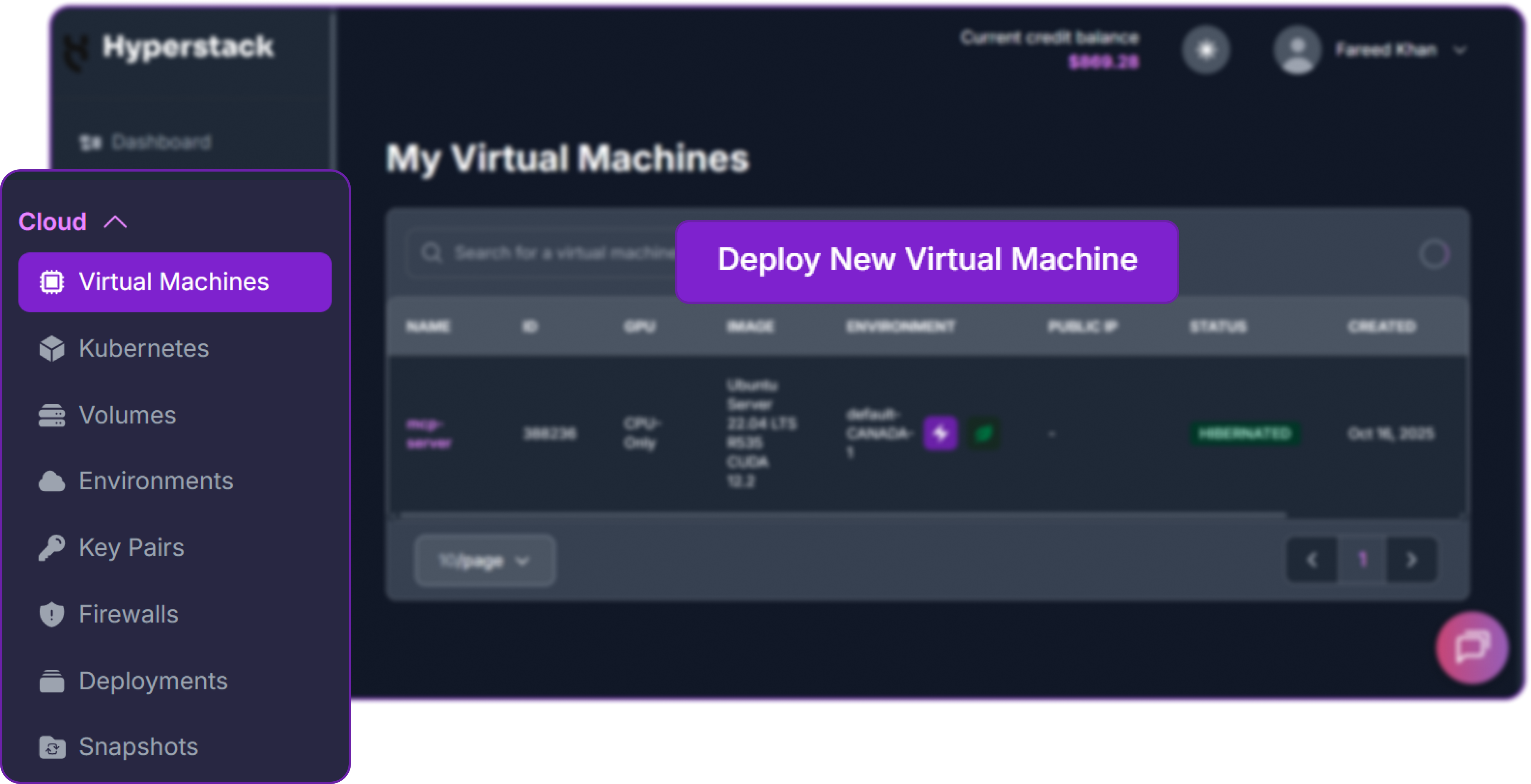
- Select Hardware Configuration: For efficient inference with tensor parallelism is key. Choose the "8xH100-80G-PCIe" flavour to ensure sufficient VRAM and memory bandwidth.

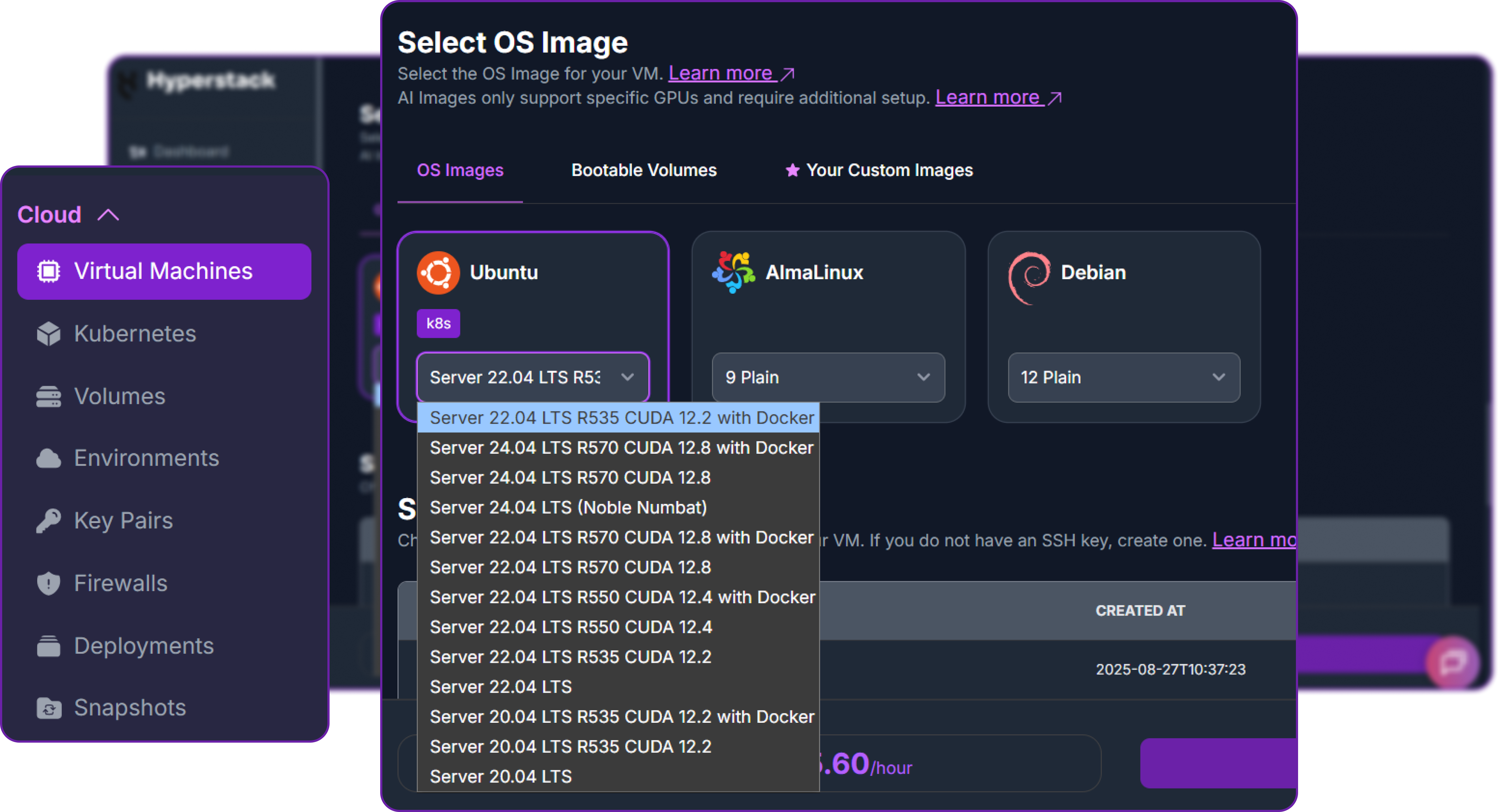
- Choose the Operating System: Select the "Ubuntu Server 22.04 LTS R535 CUDA 12.2 with Docker" image. This provides a ready-to-use environment with all necessary drivers.
- Select a Keypair: Choose an existing SSH keypair from your account to securely access the VM.
- Network Configuration: Ensure you assign a Public IP to your Virtual Machine. This is crucial for remote management and connecting your local development tools.
- Review and Deploy: Double-check your settings and click the "Deploy" button.
Step 3: Accessing Your VM
Once your VM is running, you can connect to it.
-
Locate SSH Details: In the Hyperstack dashboard, find your VM's details and copy its Public IP address.
-
Connect via SSH: Open a terminal on your local machine and use the following command, replacing the placeholders with your information.
# Connect to your VM using your private key and the VM's public IP
ssh -i [path_to_your_ssh_key] ubuntu@[your_vm_public_ip]
Here you will replace [path_to_your_ssh_key] with the path to your private SSH key file and [your_vm_public_ip] with the actual IP address of your VM.
Once connected, you should see a welcome message indicating you're logged into your Hyperstack VM.
Now that we are inside the VM, we will use Docker to launch the vLLM server.
Step 4: Create a Model Cache Directory
We'll create a directory on the VM's high-speed ephemeral disk. Storing the model here ensures faster loading times on startup.
# Create a directory for the Hugging Face model cache
sudo mkdir -p /ephemeral/hug

# Grant full read/write permissions to the directory
sudo chmod -R 0777 /ephemeral/hug
This command creates a folder named hug inside the /ephemeral disk and sets its permissions so that the Docker container can read and write the model files.
Step 5: Launch the vLLM Server
We will use the nightly vllm-openai Docker image. Although vLLM itself provides specific images such as vllm/vllm-openai:qwen3_5 for Qwen 3.5, note that we are using specific flags like --tool-call-parser to enable the advanced agentic features of Qwen3.5.
# Pull the latest vLLM OpenAI image from Docker Hub
docker pull vllm/vllm-openai:nightly

# Run the container with the specified configuration
docker run -d \
 --gpus all \
 --ipc=host \
 --network host \
 --name vllm_qwen35 \
 -e VLLM_ALLREDUCE_USE_SYMM_MEM=0 \
 -v /ephemeral/hug:/root/.cache/huggingface \
 vllm/vllm-openai:nightly \
 Qwen/Qwen3.5-397B-A17B-FP8 \
 --tensor-parallel-size 8 \
 --max-model-len 262144 \
 --enforce-eager \
 --reasoning-parser qwen3 \
 --enable-auto-tool-choice \
 --tool-call-parser qwen3_coder \
 --gpu-memory-utilization 0.90 \
 --host 0.0.0.0 \
 --port 8000
This command instructs Docker to:
--gpus all: Use all available NVIDIA GPUs on the host machine.--ipc=host: Share the host’s IPC namespace to improve multi-GPU communication performance.--network host: Expose the container directly on the host network for simpler API access.-v /ephemeral/hug:/root/.cache/huggingface: Mount the Hugging Face cache directory to persist downloaded model weights and avoid re-downloading.Qwen/Qwen3.5-397B-A17B-FP8: Load the Qwen 3.5 397B FP8 model from Hugging Face.--tensor-parallel-size 8: Split the model across 8 GPUs for large-scale tensor parallelism.--max-model-len 262144: Set the maximum supported context length to 262,144 tokens.--reasoning-parser qwen3: Enable the Qwen3 reasoning parser for structured reasoning outputs.--enable-auto-tool-choice: Allow the model to automatically decide when to invoke tools.--tool-call-parser qwen3_coder: Use the Qwen3 coder-specific tool-call parser for agent-style tool interactions.--gpu-memory-utilization 0.90: Allocate up to 90% of available GPU memory for model weights and KV cache.
Step 6: Verify the Deployment
First, check the container logs to monitor the model loading process. This may take several minutes.
docker logs -f vllm_qwen3
The process is complete when you see the line: INFO: Uvicorn running on http://0.0.0.0:8000.
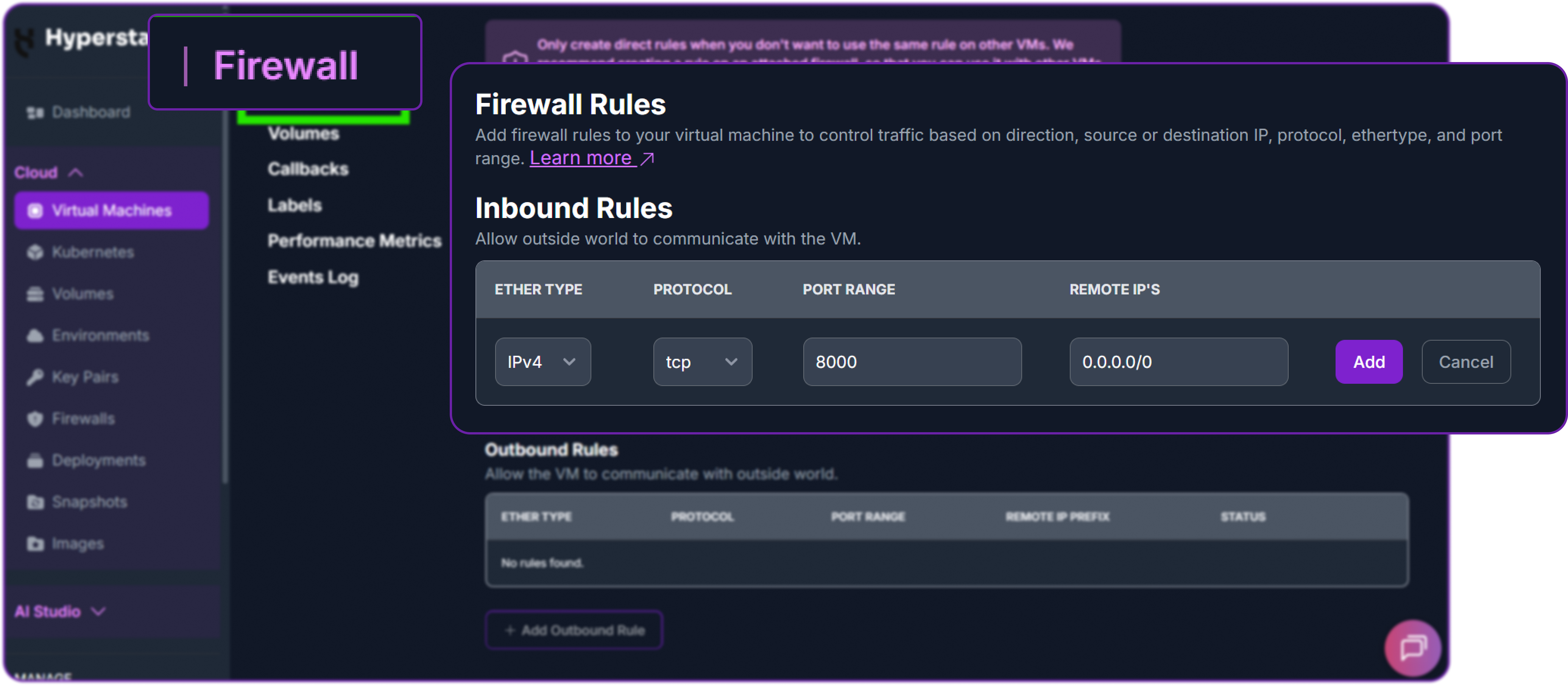
Next, add a firewall rule in your Hyperstack dashboard to allow inbound TCP traffic on port 8000. This is essential for external access.
Finally, test the API from your local machine (not the VM) by replacing the IP address with your VM's IP address.
# Test the API endpoint from your local terminal
curl http://<YOUR_VM_PUBLIC_IP>:8000/v1/chat/completions \
  -H "Content-Type: application/json" \
  -H "Authorization: Bearer EMPTY" \
  -d '{
    "model": "Qwen/Qwen3.5-397B-A17B-FP8",
    "messages": [
      {"role": "user", "content": "Type \"I love Qwen3.5\" backwards"}
    ],
    "max_tokens": 200,
    "temperature": 0.6,
    "top_p": 0.95,
    "extra_body": {
        "top_k": 20
    }
  }'
You can see that we have a successful response as a JSON object containing the model reply:
{
  "id": "chatcmpl-b290028506a93865",
  "object": "chat.completion",
  "created": 1771864485,
  "model": "Qwen/Qwen3.5-397B-A17B-FP8",
  "choices": [
    {
      "index": 0,
      "message": {
        "role": "assistant",
        "content": "Thinking Process:\n\n1. **Analyze the Request:**\n   * Input: \"Type \"I love Qwen3.5\" backwards\"\n   * Task: Reverse the string \"I love Qwen3.5\".\n\n2. **Perform the Reversal:**\n   * Original string: `I love Qwen3.5`\n   * Reversed: `5.3newQ evol I`\n\n3.",
        ...
      },
      "finish_reason": "stop"
    }
  ],
  ...
}Note that Qwen team recommends using the following set of sampling parameters for generation:
# Thinking mode
temperature=0.6, top_p=0.95, top_k=20, min_p=0.0,
presence_penalty=0.0, repetition_penalty=1.0

# Instruct (or non-thinking) mode
temperature=0.7, top_p=0.8, top_k=20, min_p=0.0,
presence_penalty=1.5, repetition_penalty=1.0
You can see that our model is responding correctly to our query which means Qwen/Qwen3.5-397B-A17B-FP8 is successfully deployed on Hyperstack.
Step 7: Hibernating Your VM (OPTIONAL)
When you are finished with your current workload, you can hibernate your VM to avoid incurring unnecessary costs:
- In the Hyperstack dashboard, locate your Virtual machine.
- Look for a "Hibernate" option.
- Click to hibernate the VM, which will stop billing for compute resources while preserving your setup.
Disabling "Thinking" Style for Concise Responses
Now that we have successfully deployed the vLLM server with the Qwen 3.5 model, we can interact with it using the OpenAI API format. First, we need to install the OpenAI Python client library to send requests to our local vLLM server.
# Install the OpenAI Python client library to interact with the vLLM server
pip3 install openai
We can now instantiate an OpenAI-compatible client in Python that points to our local vLLM server. Since vLLM typically does not enforce API keys, we can use a placeholder value for the api_key parameter.
from openai import OpenAI

# Create an OpenAI-compatible client that points to a local vLLM server.
client = OpenAI(
    base_url="http://localhost:8000/v1",  # Local API endpoint exposing OpenAI-style routes
    api_key="EMPTY",                      # Placeholder key; vLLM typically does not enforce API keys
)
Since Qwen 3.5 is a thinking model with advanced reasoning capabilities, but thinking requires more tokens and may not be suitable for all use cases, we can disable the "thinking" style on inference to get more concise responses.
This can be useful when tasks are pretty straightforward and don't require the model to show its internal reasoning process, such as simple code generation or direct question answering.
# Define the conversation payload sent to the model.
# Here, the user asks for a short Python script that reverses a string.
messages = [
    {"role": "user", "content": "Write a quick Python script to reverse a string."}
]

# Send a chat completion request to the local vLLM server via the OpenAI-compatible client.
chat_response = client.chat.completions.create(
    model="Qwen/Qwen3.5-397B-A17B-FP8",   # Model to use for generation
    messages=messages,                    # Chat history / prompt messages
    max_tokens=500,                       # Maximum number of tokens in the model response
    temperature=0.7,                      # Sampling randomness (higher = more creative)
    top_p=0.8,                            # Nucleus sampling threshold
    presence_penalty=1.5,                 # Penalize repeated topics to encourage novelty
    extra_body={
        "top_k": 20,                      # Restrict sampling to top-k candidates
        "chat_template_kwargs": {
            "enable_thinking": False      # Disable internal "thinking" style output
        },
    },
)
In here we are asking the model to generate a Python script that reverses a string. By setting enable_thinking to False, we are instructing the model to skip the detailed reasoning process and directly provide the final answer, which should be a concise Python code
Finally, we can print the generated response from the model, which should contain a Python script that reverses a string.
# Print the generated text from the first returned choice.
print("Chat response:", chat_response.choices[0].message.content)
This is what we are getting:
Chat response: Here is a quick and efficient Python script to reverse a string using slicing:

```python
def reverse_string(text):
    return text[::-1]

# Example usage
if __name__ == "__main__":
    user_input = input("Enter a ...
Our Qwen 3.5 model successfully generated a Python script that reverses a string, and it did so without including the internal "thinking" process in the output, resulting in a concise and direct answer.
Multimodal Capabilities with Qwen 3.5
Qwen 3.5 is also a multimodal model, which means it can process and understand both text and images. This allows us to create prompts that include images along with text questions, and the model can analyze the image to provide relevant answers.
For example, we can build a multimodal chat prompt that includes an image URL and a text question about the image.
# Build a multimodal chat prompt with one user message:
# - an image URL
# - a text question about the image
messages = [
    {
        "role": "user",
        "content": [
            {
                "type": "image_url",
                "image_url": {
                    # Public image to analyze
                    "url": "https://qianwen-res.oss-accelerate.aliyuncs.com/Qwen3.5/demo/RealWorld/RealWorld-04.png"
                }
            },
            {
                "type": "text",
                # Question for the model based on the provided image
                "text": "Where is this?"
            }
        ]
    }
]
In our messages payload, we have a single user message that contains two parts: an image URL and a text question. The model will process the image at the provided URL and attempt to answer the question "Where is this?" based on the visual content of the image.
# Send the request to the local vLLM server via OpenAI-compatible client
chat_response = client.chat.completions.create(
    model="Qwen/Qwen3.5-397B-A17B-FP8",  # Model identifier
    messages=messages,                    # Multimodal user prompt
    max_tokens=600,                       # Max tokens in generated response
    temperature=0.6,                      # Sampling randomness
    top_p=0.95,                           # Nucleus sampling threshold
    extra_body={
        "top_k": 20,                      # Restrict sampling to top-k candidates
    },
)

# Print the first completion text returned by the model
print("Chat response:", chat_response.choices[0].message.content)
We can initialize the OpenAI-compatible client and send the multimodal prompt to our local vLLM server. This is what we get back from the model:
Chat response: The user wants to know the location of the image.

1.  **Analyze the image:**
    *   **Foreground:** There's a large statue of a person (looks like
        an indigenous figure) with a golden headband.
        Below it, there's a sign that says "@rigen" in a cursive font.
        There's also a colorful floor or platform. ...
You can see that the model is able to analyze the image and provide a detailed response about its content, demonstrating its multimodal understanding capabilities.
We can also process video inputs in a similar way by providing a video URL in the prompt. The model can analyze the video frames and answer questions about the video content.
# Build a multimodal prompt:
# - one video input (URL)
# - one text question about the video content
messages = [
    {
        "role": "user",
        "content": [
            {
                "type": "video_url",
                "video_url": {
                    # Public video to analyze
                    "url": "https://qianwen-res.oss-accelerate.aliyuncs.com/Qwen3.5/demo/video/N1cdUjctpG8.mp4"
                }
            },
            {
                "type": "text",
                # Question based on the video
                "text": "How many porcelain jars were discovered in the niches located in the primary chamber of the tomb?"
            }
        ]
    }
]
In our messages payload, we have a user message that includes a video URL and a text question about the video content.
# Send the chat completion request to the local vLLM server
chat_response = client.chat.completions.create(
    model="Qwen/Qwen3.5-397B-A17B-FP8",  # Model identifier
    messages=messages,                   # Multimodal conversation payload
    max_tokens=600,                      # Maximum tokens in response
    temperature=0.6,                     # Sampling randomness
    top_p=0.95,                          # Nucleus sampling threshold
    extra_body={
        "top_k": 20,                     # Restrict token sampling to top-k candidates
        # Video frame sampling config: sample frames at 2 FPS
        "mm_processor_kwargs": {"fps": 2, "do_sample_frames": True},
    },
)

# Print the generated answer from the first completion choice
print("Chat response:", chat_response.choices[0].message.content)
In here we are specifying additional parameters in the extra_body to configure how the model processes the video input. By setting do_sample_frames to True and specifying fps: 2, we are instructing the model to sample frames from the video at a rate of 2 frames per second for analysis.
This is what we get back from the model:
Chat response: The user is asking about the number of porcelain jars
discovered in the niches located in the primary chamber of a tomb, based
on the ...
You can see that the model is able to analyze the video content and provide a relevant response to the user's question, demonstrating its ability to understand and process video inputs in a multimodal context.
Agentic Use Case with Qwen 3.5
One of the most powerful features of Qwen/Qwen3.5-397B-A17B-FP8 is its advanced agentic tool-calling capability.
Unlike a standard chat interaction where the model simply generates text, an agentic workflow allows the model to:
- Decide when external tools are needed
- Call tools automatically
- Receive tool outputs
- Continue reasoning using those outputs
- Complete multi-step tasks autonomously
Qwen team recommends using Qwen-Agent, a Python framework for building agent applications, to fully leverage these capabilities. First, let's install Qwen-Agent in your local Python environment:
# Install Qwen-Agent for building agent applications
pip3 install qwen-agent
We will configure Qwen-Agent to use our locally deployed vLLM server instead of external APIs.
import os
from qwen_agent.agents import Assistant

# Define LLM configuration pointing to our local vLLM server
llm_cfg = {
    # Use our OpenAI-compatible vLLM endpoint
    'model': 'Qwen/Qwen3.5-397B-A17B-FP8',
    'model_type': 'qwenvl_oai',
    'model_server': 'http://localhost:8000/v1',  # Local API endpoint
    'api_key': 'EMPTY',  # Placeholder key (vLLM does not enforce API keys)

    'generate_cfg': {
        'use_raw_api': True,
        # When using vLLM OpenAI-compatible API,
        # enable or disable thinking mode using chat_template_kwargs
        'extra_body': {
            'chat_template_kwargs': {'enable_thinking': True}
        },
    },
}
In this configuration, we are doing the following:
model_serverpoints to our local vLLM deployment.enable_thinkingis set toTrueto allow structured reasoning.use_raw_apiensures Qwen-Agent sends requests in OpenAI-compatible format.
Now we define a tool using the Model Context Protocol (MCP). This example uses the official MCP filesystem server.
# Define available tools for the agent
tools = [
    {
        'mcpServers': {
            # Filesystem MCP server configuration
            "filesystem": {
                "command": "npx",
                "args": [
                    "-y",
                    "@modelcontextprotocol/server-filesystem",
                    "/ephemeral/agent_workspace"  # Directory accessible to the agent
                ]
            }
        }
    }
]
This configuration:
- Launches an MCP filesystem server using
npx - Grants the model access to
/ephemeral/agent_workspace - Allows the model to read, write, edit, and organize files within that directory
For security purposes, it is recommended to expose only a dedicated workspace directory rather than the entire system.
Now we can initialize the agent with the specified LLM configuration and tools.
# Initialize the agent
bot = Assistant(llm=llm_cfg, function_list=tools)
At this point, the model is capable of:
-
Understanding user instructions
-
Deciding when to use filesystem tools
-
Executing file operations
-
Continuing reasoning after tool execution
Example 1: Organizing the Desktop
We now provide a user instruction that requires filesystem interaction.
# Streaming generation example
messages = [{'role': 'user', 'content': 'Help me organize my /ephemeral/agent_workspace desktop. There are many files and folders all over the place.'}]

# Run the agent with the provided messages and stream responses
for responses in bot.run(messages=messages):
    pass

# Print the final responses from the agent after processing the instruction
print(responses)
We are asking the agent to help organize the /ephemeral/agent_workspace desktop. The model will autonomously decide to use the filesystem tool to analyze the desktop contents, create folders, and move files accordingly.
This is what happens internally:
- The model analyzes the request.
- It decides that filesystem access is required.
- It calls the MCP filesystem tool.
- The tool returns file listings.
- The model generates a plan to organize files.
- It may create folders and move files accordingly.
- It returns a summary of actions performed.
I have included couple different files in the /ephemeral/agent_workspace desktop for testing. After running the above code, we get the following output from the agent:
<think>
Checking the contents of the desktop...
The desktop contains multiple files including documents, images, and scripts.

I created the following folders:
- Documents
- Images
...
You can see that the model is able to analyze the desktop contents, decide on an organizational structure, and perform file operations autonomously using the MCP filesystem tool.
Example 2: Develop a Website and Save It to the Desktop
Now we provide a more advanced instruction:
# Streaming generation example
messages = [{'role': 'user', 'content': 'Develop a dog website and save it on the /ephemeral/agent_workspace desktop.'}]

# Run the agent with the provided messages and stream responses
for responses in bot.run(messages=messages):
    pass

# Print the final responses from the agent after processing the instruction
print(responses)
In here, we are asking the agent to develop a dog-themed website and save it on the /ephemeral/agent_workspace desktop.
This is what happens internally:
- The model interprets the request.
- It generates HTML content for a dog-themed website.
- It calls the filesystem tool.
- It creates
index.htmlin the specified directory. - It writes the generated HTML code into the file.
- It confirms completion.
I have created a file named "index.html" on the desktop.

The website includes:
- A header section
- A description of dogs
- An image placeholder
- Basic styling with CSS

You can open the file in your browser to view the website.
The actual directory now contains:
/ephemeral/agent_workspace/index.htmlThis file can be opened directly in a browser. This is what our simple website looks like:

Perfect, it includes a header, description, image placeholder, and basic styling, all generated autonomously by the agent using the Qwen 3.5 model and the MCP filesystem tool.
Why Deploy Qwen3.5 on Hyperstack?
Hyperstack is a cloud platform designed to accelerate AI and machine learning workloads. Here's why it's an excellent choice for deploying Qwen3.5:
- Availability: Hyperstack provides access to the latest and most powerful GPUs such as the NVIDIA H100 on-demand, specifically designed to handle large language models.
- Ease of Deployment: With pre-configured environments and one-click deployments, setting up complex AI models becomes significantly simpler on our platform.
- Scalability: You can easily scale your resources up or down based on your computational needs.
- Cost-Effectiveness: You pay only for the resources you use with our cost-effective cloud GPU pricing.
- Integration Capabilities: Hyperstack provides easy integration with popular AI frameworks and tools.
FAQs
What is Qwen3.5?
Qwen3.5 is an open-weight, native vision-language model built by the Qwen Team. It uses a highly efficient Mixture-of-Experts (MoE) architecture (397B total parameters, but only 17B active at a time) to power advanced, multimodal digital agents without slowing down.
What is the context window of Qwen3.5?
The model natively supports a massive 262,144-token context window. With special scaling techniques (like YaRN), it can even be extended to process over 1 million tokens, allowing you to feed it massive codebases or up to two hours of video.
Does Qwen3.5 support "thinking" mode?
Yes! In fact, Qwen3.5 operates in "thinking" mode by default. It naturally generates <think>...</think> blocks to reason through complex problems step-by-step before giving a final answer. (You can turn this off via API settings if you just want a direct response).
What hardware is required for Qwen3.5?
Even though it is highly efficient and only activates 17B parameters during generation, you still need to load all 397B parameters into memory. This requires significant VRAM, typically needing a setup of 8 high-end GPUs (like 8x 80GB H100s or A100s) to run smoothly.
What are the main use cases for this model?
Qwen3.5 is perfectly suited for building universal AI agents. It excels at complex visual reasoning, automating computer and smartphone interfaces (GUI automation), deeply analysing long videos, and autonomous "vibe coding" alongside tools like Qwen Code and OpenClaw.
Subscribe to Hyperstack!
Enter your email to get updates to your inbox every week