



TABLE OF CONTENTS
NVIDIA H100 SXM On-Demand
• Kubernetes is used to orchestrate containerised applications with automated deployment, scaling, and self-healing.
• It enables microservices architectures by managing service discovery, load balancing, and rolling updates.
• Kubernetes supports AI and machine learning workloads by efficiently scheduling GPU-based training and inference jobs.
• It helps run big data and high-performance computing workloads through flexible resource allocation and parallel processing.
• Kubernetes improves application availability and reliability by automatically handling failures and restarts.
• It integrates with CI/CD workflows to streamline application delivery and operational consistency.
Every few years, the cloud-native industry hits a turning point. It is a moment where new workloads suddenly demand more scale, more automation and more resilience than the tools we relied on before. And if you’ve been anywhere near AI, you’ve probably felt this shift too.
Teams are not asking “Should we adopt Kubernetes?” anymore. They are more about “How far can Kubernetes take us?”. No matter if you’re building AI pipelines, deploying microservices across regions or scaling GPU-heavy training jobs, Kubernetes is an ideal choice for cloud-native workloads.
In this blog, we’ll break down the five most popular 5 Kubernetes use cases.
5 Popular Kubernetes Use Cases
Below we talk about some of the most popular Kubernetes use cases that will define cloud-native workloads in the coming years:
1. AI and Machine Learning (ML) Workloads
AI and ML pipelines are getting heavier, more distributed and more complex. Kubernetes is the perfect control plane to keep them running smoothly. Whether you're training large models, fine-tuning smaller ones or deploying inference endpoints with fluctuating demand, Kubernetes handles the orchestration so your team can focus on building, not maintaining.
Kubernetes natively supports GPU scheduling, job prioritisation, node autoscaling and parallel processing, all essential for model training and batch workloads. Tools like Kubeflow, Ray, MLflow and Argo Workflows plug directly into K8s, turning your cluster into a fully automated ML engine. You define the workflow once and Kubernetes ensures every step runs reliably, reproducibly and efficiently.
2. Microservices Architecture
Microservices thrive when each service can move at its own pace and Kubernetes is the technology that makes that possible. Instead of shipping one massive application, teams break everything into smaller, independent services that can be deployed, updated and scaled on demand. Kubernetes handles the orchestration automatically, ensuring every service has the resources it needs and can communicate reliably with the rest of the system.
With features like rolling updates, self-healing, service discovery and horizontal pod autoscaling, Kubernetes removes the heavy lifting that used to bog down microservices operations. Need to scale your API service during peak hours? K8s handles it. Want to deploy a fix to one service without touching the rest? Easy. Want traffic routing, health checks and zero-downtime rollouts? It’s built in. The result you get is a faster, more resilient architecture where teams ship updates frequently without breaking the entire application.
3. Large-Scale Application Deployment and Management
Running a large-scale AI application is not just about compute power. It is about orchestrating hundreds of moving parts without losing reliability. Kubernetes becomes important here by automating deployment, scaling, traffic routing and failover, making it far easier to operate applications that serve millions of users or handle complex dependency chains.
Instead of manually provisioning capacity or firefighting outages, Kubernetes continuously monitors the state of your application and adjusts resources in real time. Horizontal scaling kicks in during traffic spikes, while replica sets ensure your app stays available even if nodes fail. Deployments and rollbacks are seamless, giving engineering teams the confidence to push updates more frequently.
For businesses dealing with unpredictable traffic, regional rollouts, multi-tier architectures or mission-critical uptime requirements, Kubernetes provides a stable and self-healing foundation. It takes care of the operational complexity so large applications stay responsive and easy to manage, no matter how fast they grow.
4. High-Performance Computing (HPC) and Big Data Workloads
High-performance computing and big data workloads demand massive parallelism, precise scheduling and efficient resource usage, all things Kubernetes handles surprisingly well. No matter if it’s scientific simulations, genome processing, financial modelling, ETL pipelines or large-scale analytics, Kubernetes gives teams a unified way to run compute-heavy jobs without building specialised infrastructure from scratch.
With support for custom resource definitions, node affinity, GPU/CPU optimisation and batch job orchestration, Kubernetes can schedule workloads across powerful clusters with fine-grained control. It ensures jobs run where the right resources exist, scales clusters automatically and balances workloads to maximise throughput. For teams that need elastic performance without rigid HPC environments, Kubernetes delivers the perfect blend of automation, scalability and cost efficiency when workloads fluctuate.
5. CI/CD Pipeline Integration and DevOps
Kubernetes has become a natural home for modern DevOps practices, especially when it comes to CI/CD automation. Instead of treating deployment environments as static servers, Kubernetes turns them into dynamic and reproducible systems where every release follows the same predictable workflow.
CI/CD tools like Argo CD, Flux, Jenkins, GitHub Actions and GitLab CI integrate directly with Kubernetes. This enables automated builds, tests, canary releases and rollbacks. When developers push code, the entire pipeline from container image creation to deployment runs end-to-end with minimal manual input.
The result is shorter release cycles, higher reliability and fewer production surprises. Kubernetes gives DevOps teams a unified platform where automation thrives for continuous delivery at scale without sacrificing control or visibility.
Conclusion
Kubernetes has transformed the way teams deploy, manage and scale applications. Each use case shows how Kubernetes removes operational friction, automates complex tasks and provides a resilient, flexible platform for cloud-native workloads.
But orchestration is only half the battle. To fully utilise Kubernetes’ potential, your clusters need the right infrastructure. That’s why you must choose Hyperstack On-Demand Kubernetes. These clusters are AI-optimised, built on GPU-enabled worker flavours with NVIDIA-optimised images, so you can run training jobs, fine-tuning pipelines, inference services and general workloads efficiently. With NVIDIA GPU support out of the box, there’s no need for manual driver installation or compatibility troubleshooting.
Deployment is seamless as you can launch Hyperstack On-Demand Kubernetes clusters in minutes, with automated node provisioning, networking, OS configuration and driver installation. High-speed, low-latency networking ensures your distributed workloads perform at peak efficiency, while node groups let you isolate and scale diverse workloads within a single cluster.
Take your Kubernetes experience to the next level and launch Hyperstack On-Demand Kubernetes today.
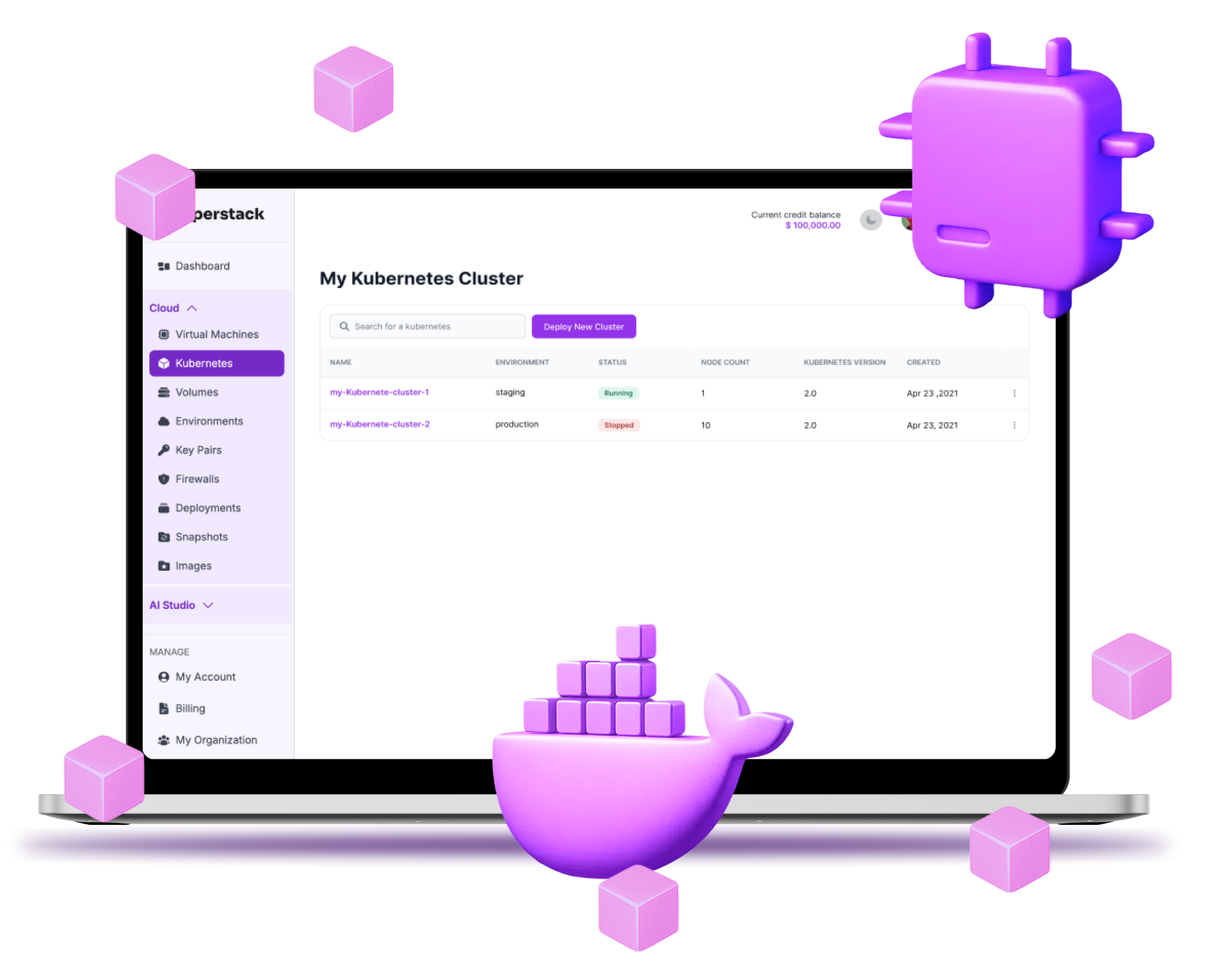
Get Started with Hyperstack On-Demand Kubernetes →
FAQs
What makes Kubernetes a good fit for AI and ML workloads?
Kubernetes provides GPU scheduling, autoscaling, job orchestration and support for frameworks like Kubeflow, Ray and MLflow. This makes it ideal for training, fine-tuning and deploying models at scale without manual infrastructure management. Its ability to handle distributed workloads and automate complex pipelines gives AI teams a consistent, reliable execution environment.
How does Kubernetes improve microservices architecture?
Kubernetes gives each service independent scaling, deployment and rollback capabilities. Built-in features like service discovery, rolling updates, health checks and self-healing ensure microservices communicate reliably and recover automatically. This helps teams deploy faster, reduce downtime and maintain a more resilient system overall.
Why choose Kubernetes for large-scale applications?
Kubernetes automates scaling, load balancing and failover, making it easier to manage applications with high traffic or complex dependencies. It constantly monitors application health and adjusts resources in real time, ensuring consistent performance even during unexpected spikes or node failures.
Can Kubernetes handle HPC and big data workloads effectively?
Yes. Kubernetes supports resource-intensive jobs through custom resource definitions, node affinity, CPU/GPU optimisation and batch processing. It distributes workloads across clusters efficiently and integrates with tools like Spark, Dask and Airflow, making it a flexible choice for scientific computing, analytics and large-scale data pipelines.
Why use Hyperstack for Kubernetes deployments?
Hyperstack offers on-demand, AI-optimised Kubernetes clusters with GPU-enabled worker flavours and NVIDIA-optimised images. Clusters deploy in minutes with preconfigured networking, security, drivers and node groups. This eliminates infrastructure complexity, enabling teams to run AI, ML, HPC and cloud-native workloads with maximum performance and minimal setup.
Subscribe to Hyperstack!
Enter your email to get updates to your inbox every week